What envelope budgeting is
The idea is old and simple. When the salary arrives, you divide it into envelopes: one for the home, one for food, one for savings, one for fun. Each envelope has a label and a limit. Groceries come out of the groceries envelope, and when it's empty you stop buying extras or you consciously move money from another envelope.
It works because it turns one big, vague number ("we earned 5,200 this month") into a handful of small, concrete ones ("we have 140 left for food until the 30th"). Most people can't keep a full budget in their head. Almost everyone can keep four numbers there.
You'll also see it called the envelope system, the envelope method or cash stuffing. Cash stuffing is the version with real paper envelopes and banknotes. The method is the same whether the envelopes are paper or a few lines in an app.
Cash envelopes or digital envelopes
With cash, the limit enforces itself: when the envelope is empty, there's nothing to spend. That's the strongest argument for it. The downsides are practical. You need to withdraw cash, rent and online purchases can't be paid from an envelope, and two partners can't easily share one envelope across town.
With digital envelopes, the money stays in your bank accounts and the envelopes exist in a spreadsheet or an app. You pay by card as usual, and each purchase is recorded against an envelope. The limit only works if you look at what's left, so the habit that matters is checking the envelope before a bigger purchase.
| Cash envelopes | Digital envelopes | |
|---|---|---|
| Limit | Physical: empty means empty | Shown as a number you have to check |
| Card and online payments | Not possible from the envelope | Normal |
| Shared by a couple | Hard if you're not together | Both see the same envelopes |
| Effort | Withdrawals, counting, refilling | Recording each purchase (or importing statements) |
| Good for | One problem category, like eating out | The whole household budget |
A common mix: digital envelopes for the whole budget, plus one cash envelope for the category that keeps getting away from you.
How to set up envelope budgeting in 7 steps
- Take your net monthly income: what actually lands in your accounts after tax, for everyone in the household who shares the budget.
- List the fixed costs that leave every month no matter what: rent or mortgage, utilities, insurance, loan payments, subscriptions, childcare.
- Pick 4 to 6 envelopes. Fewer is better at the start. A typical household set is living costs, savings, debt payments and fun or travel.
- Give each envelope a size, either as an amount or as a percentage of income (more on the difference below). The sizes should add up to 100% of income, so every euro has a job.
- Put categories inside each envelope. Groceries, transport, utilities and kids' costs sit inside living costs. Each category can have its own share of its envelope.
- Record every purchase against a category, from receipts, card statements or by hand. Check what's left in an envelope before any purchase that isn't routine.
- At the end of the month, decide what happens to money left in each envelope, and start the next month with fresh targets.
Want this set up for your household? Join the early-access list.Get early access
Fixed amounts or percentages of income
Most envelope guides tell you to put a fixed amount in each envelope: 600 for groceries, 200 for fun. That works when income is the same every month. When it isn't (overtime, commissions, a partner on parental leave, freelance work), fixed amounts break: in a good month money sits outside the plan, and in a lean month the envelopes add up to more than you earned.
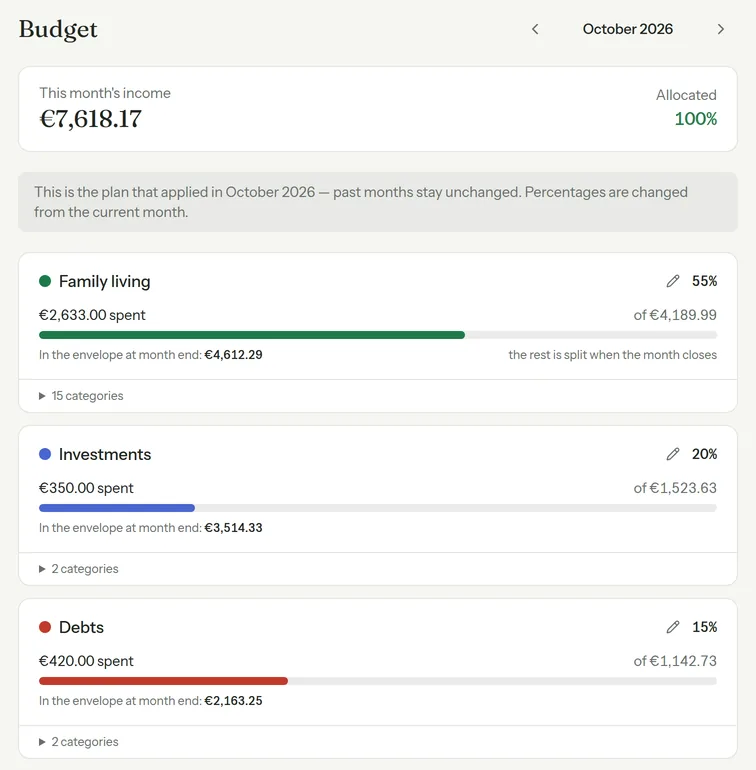
The alternative is to size envelopes as a percentage of the income that actually came in that month. The plan stays the same, and the amounts follow your income up and down. This is how Kinjar's budget works: you set the percentages once, and every month the targets are calculated from that month's real income.
Other apps use other methods, such as fixed-amount envelopes or zero-based plans. Our comparison of the best budget apps by budgeting method shows which one fits which approach, and the YNAB alternatives page covers switching.
A worked example: one household, two different months
Emma and James Carter share one budget. In October their two salaries add up to €5,200 net. They use four envelopes, sized as percentages:
| Envelope | Share | Target | What's inside |
|---|---|---|---|
| Living costs | 55% | €2,860 | Rent, utilities, groceries, transport, kids |
| Savings and investing | 20% | €1,040 | Emergency fund, investment account |
| Debt payments | 15% | €780 | Car loan, credit card |
| Fun and travel | 10% | €520 | Eating out, holidays, gifts |
In November James works fewer hours and their income is €4,600. With percentages, nobody has to redo the plan. The targets simply follow:
| Envelope | Share | October (€5,200) | November (€4,600) |
|---|---|---|---|
| Living costs | 55% | €2,860 | €2,530 |
| Savings and investing | 20% | €1,040 | €920 |
| Debt payments | 15% | €780 | €690 |
| Fun and travel | 10% | €520 | €460 |
One check matters here: fixed costs don't shrink with income. The Carters' rent, utilities and minimum loan payments come to about €2,300, which still fits inside €2,530. If a lean month pushed living costs below the fixed bills, the fix is to change the shares from that month on (for example 60% living, 15% savings), not to quietly overspend.
What to do with money left in an envelope
At month end some envelopes will have money left. There are two sensible rules, and you can use both:
- Let it roll over. Savings, debt and travel envelopes should keep their balance from month to month, because they're building toward something.
- Sweep the everyday envelope. Money left in living costs is a surplus, and it's better to send it somewhere on purpose than to let it fund next month's impulse buys.
Example: the Carters finish November with €300 left in living costs. They split it between the other envelopes in proportion to their shares (20, 15 and 10): €133.33 to savings, €100 to debt payments and €66.67 to fun and travel. In Kinjar this is the month closing: you mark one envelope as the everyday spending envelope, and when you close the month its unspent rest is split among the other envelopes by their percentages.
When an envelope runs out before the month does
It will happen, especially in the first two months while the shares are still guesses. What you do next decides whether the system survives:
- Move money from another envelope, on purpose, and write it down. Taking €80 from fun and travel to cover groceries is the system working, not failing.
- Don't borrow from savings without noticing. If you do it twice in a row, the share for that envelope is too small. Raise it for next month.
- Look at what emptied it. Often it's one category inside the envelope (eating out inside "food", for example) that needs its own limit.
Envelope budgeting as a couple
Envelopes are a good fit for couples because they replace arguments about individual purchases with one shared question: is there money in the envelope? Two things make it work:
- One shared set of envelopes that both of you can see, updated by both of you. If only one partner records spending, the other is guessing.
- A short weekly check together: what's left in each envelope, anything big coming up, any money to move. Ten minutes on a Sunday is enough.
In Kinjar a partner joins the household with an invite code and sees the same ledger and envelopes. Spending gets in from receipt photos and bank statement files, so neither of you has to type every purchase. The features page shows how each part works, and our guide to budget apps for couples compares the options if you're still choosing.
Envelope categories to start with
If you're not sure what to put where, this split works for most households and is easy to change later:
- Living costs: rent or mortgage, utilities, phone and internet, groceries, household supplies, transport, childcare, health.
- Savings and investing: emergency fund, yearly costs saved monthly (insurance, car service, school fees), investment account.
- Debt payments: every loan and card payment, plus anything extra you pay down.
- Fun and travel: eating out, hobbies, holidays, gifts and celebrations.
Start with a few envelopes and broad categories. You can split them once you've seen two or three months of real spending.